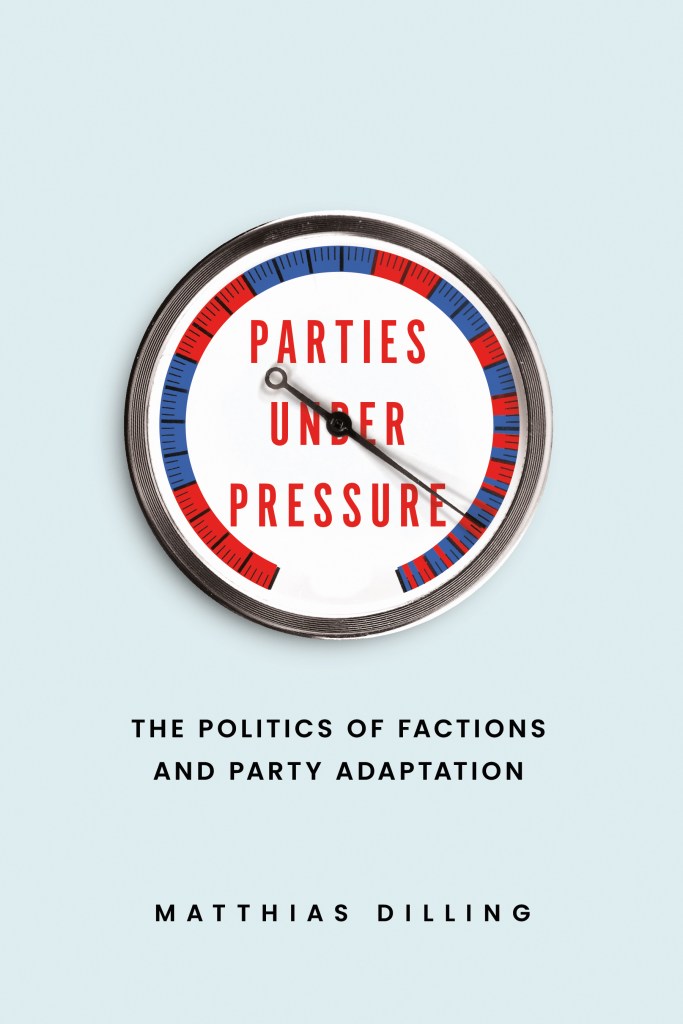
Parties under Pressure: The Politics of Factions and Party Adaptation
University of Chicago Press, published in August 2024
Winner of the 2025 Brian Farrell Book Prize of the Political Studies Association of Ireland
Around the world, established political parties face mounting pressures: insurgents on the Left and Right, altered media environments, new policy challenges, and the erosion of traditional strongholds, to name just a few. Yet parties have differed enormously in their ability to move with the times and update their offers to voters. This variation matters. While adaptation does not guarantee electoral success, parties’ failure to modernize has often resulted in their decline, even collapse, and created openings for radical and populist parties that may threaten the future of liberal democracy.
My book examines why some parties adapt meaningfully to social, economic, and political transformations while others flounder. Focusing on the varying fate of one of postwar Europe’s dominant party families – Christian Democracy, the book uncovers the under-appreciated importance of party factions, defined as organized internal groups with weak formal ties to the central party. While very high levels of factionalism are counter-productive and create paralysis, more moderate levels of factionalism help parties to adapt by giving visibility to fresh groups and ideas. Contrasting this argument with alternative accounts from the party change literature and drawing on institutional theory, this book is the first systematic look at the emergence and development of different levels of factionalism and their effect on party adaptation. Based on extensive archival research in Germany, Italy, and Austria, as well as evidence from France, Japan, and beyond, the book sheds new light on parties’ varying records of adaptive reforms over more than seventy-five years.
You can order the book here. You can read reviews of the book in Party Politics here, in German Politics here, and in Political Science Quarterly here.
Supplementary material 1 can be accessed here.
Supplementary material 2 can be accessed here.
 Matthias Dilling